ARTimus Prime is your destination to check out all the projects going on at the Fountain Lake Cobra Digital Prep Academy. Bookmark this page to check back here all year to see what we are doing in the Art Room and to keep up with all of your assignments.
Our next project takes a look at contemporary artist Eric Joyner and creating a metallic effect with colored pencils by blending them together.
Contemporary art is the art of today, produced by artists who are living in the twenty-first century. Contemporary art provides an opportunity to reflect on contemporary society and the issues relevant to ourselves, and the world around us.
Take a look here for more examples of contemporary art:
In 1999, I started to enter various juried shows at Artisans Gallery in Mill Valley, CA. and the work was well received. Shows in other galleries, (usually group shows) were positive as well. In 2000, after years of painting other people’s pictures, I made the decision to only paint things that I liked. Four series of paintings of different subjects were started; they were: San Francisco urbanscapes, paintings of old newspaper cartoons characters, Mexican masks, and last but not least, Japanese tin (toy) robots. Though all four series of these subjects were enjoyable to do, I chose to focus on the tin robots, as they were the most popular and seemed to have the most possibilities.
So, armed with a small collection of tin robots and spaceships I began painting them in earnest. In attempt to bring them to life without losing their charm, I showed them where they belonged: outer space. By 2002 the paintings were looking good, but they still needed something to play off of… perhaps a nemesis. After a month or so of searching for a ‘nemesis’ I had an epiphany while watching the movie ‘Pleasantville.’ In one of the scenes, Jeff Daniels paints a still life of…donuts. With thoughts of Wayne Thiebaud’s pastries always close at hand, it wasn’t difficult to see the battle scene of robots retreating from 300-foot tall donuts when I went to bed that night. The rest, as they say, is history.
This video is a tutorial showing some different colors you can blend together to create some metallic textures.
Directions:
Create a robot artwork inspired by Eric Joyner.
Add donuts (or another type of sweet treat) to your robot drawings like Eric Joyner.
Create a metallic texture on your robot using the blending techniques we worked on in class.
There are many robot part examples below here for inspiration.
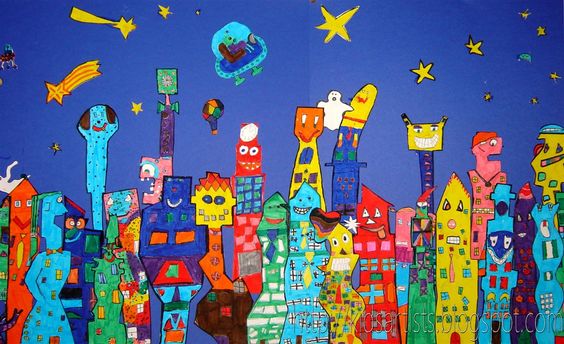
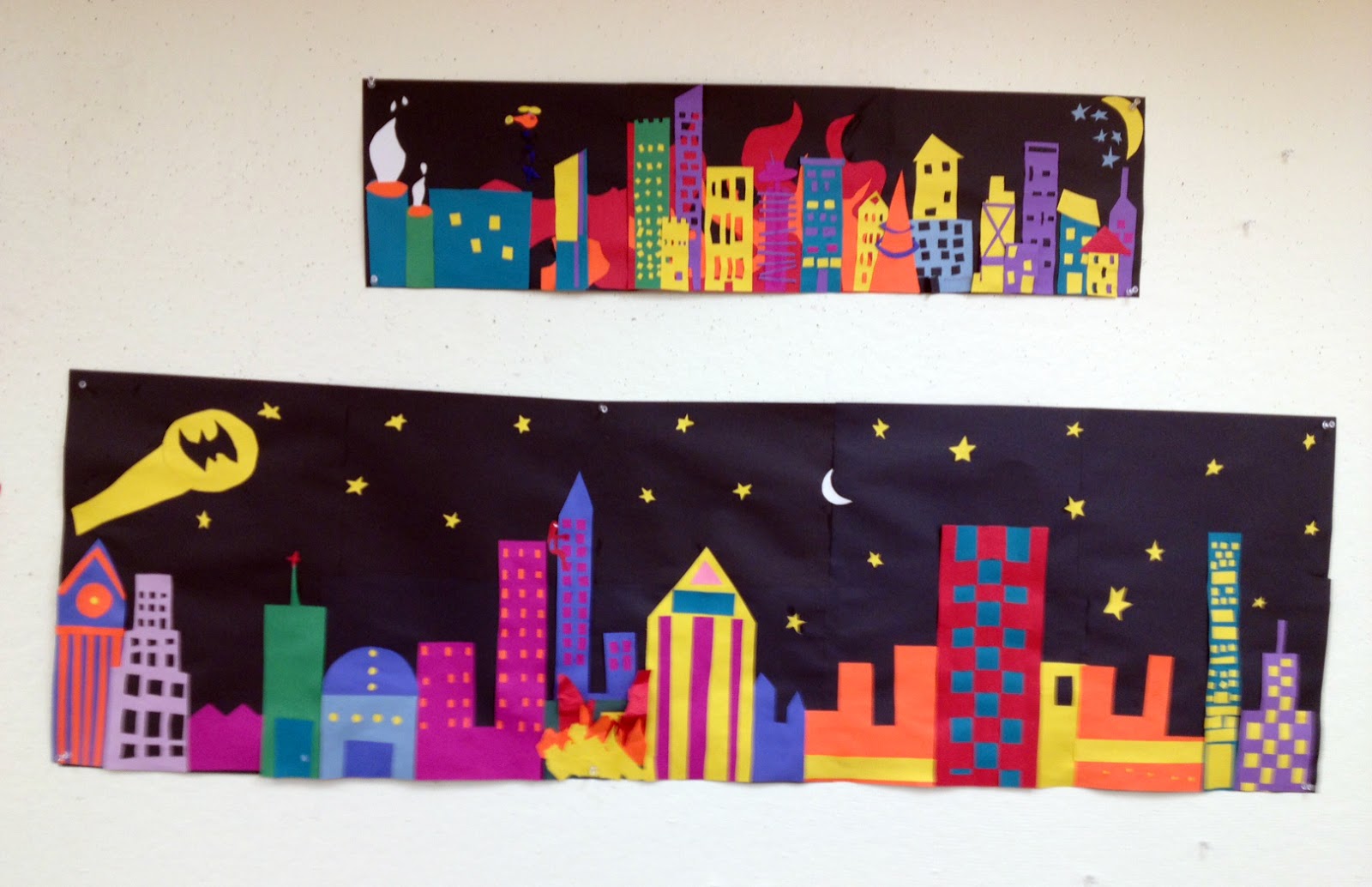
Welcome young architects and city planners! Today, we'll embark on an exciting creative journey where you'll work together to design and draw a futuristic cityscape. Your task is to draw two innovative skyscrapers that could exist in the future, incorporating unique features like sky gardens, solar panels, or even landing pads for flying cars. Once everyone has completed their buildings, we'll combine all the drawings to create one massive, collaborative city of the future on a large display board. Remember, in the future, buildings might look very different from what we see today, so let your imagination soar while keeping your designs realistic enough to stand tall!
Today we are going to discuss different ways to approach being creative and brainstorming ideas.
We will look at three specific tasks to help you brainstorm in the art room- list making, mind mapping, and sketching thumbnails. All of these will help you in the design process as you create you artworks. We will go through this process as you brainstorm ideas for themes that you could use to make art this year.
List making is the easiest and quickest method of getting ideas onto paper. The most important step during this time is to write down EVERY idea. No judgement is allowed during the list making phase. The goal of this brainstorming method is to come up with as many ideas as possible, good or bad.
Today we are going to make a list based on themes in art that you may want to create art about.
After you complete your list , go through your ideas with another person and see if they have any suggestions for more ideas or if they have any constructive criticism and suggestions to remove ideas.
Refine your listy down to 3-5 ideas that you really like and are happy with to move on to the next step of brainstorming.
2. Mind Mapping
A Mind Map is an easy way to brainstorm thoughts organically without worrying about order and structure. It allows you to visually structure your ideas to help with analysis and recall.
Take a look at this link for more info on Mind Maps
Now create a mind map using your ideas from your earlier list as your main branches.
1. Start the middle of your map with ART THEMES 2021/22
2. add your list to the map as the first set of branches.
3. Add more branches and twigs to each main theme branch to expand on your ideas.
You could think about diving deeper into the theme, adding subject matter ideas, or media ideas to these branches and twigs. The choice is yours.
3. Thumbnails/Sketching
The final step in our brainstorming exercise is thumbnails and sketching.
As you heard in the video above, thumbnails are small sketches in boxes that can be as detailed as you like. Sketching is a good way to get visual information down on paper and there are many different purposes and functions that sketches can accomplish. Sketches will give you and others a rough visual outline to start your artworks.
From your mind map, choose one of your ideas that you really liked and sketch 3 thumbnail sketches of your artistic vision of this idea that you have created.
Good job! You have successfully brainstormed and created ideas for some future artworks in class. You can use all or parts of this method for future brainstorming to come up with ideas for art.
Submit you required work to Google Classroom for credit.
What is an Exquisite Corpse? Taken literally, it's a beautiful dead body. Taken artistically, it's a game poets and artists play to create surprising and unusual works of art. This lesson explores the origins and rules of the Exquisite Corpse.
Surrealism
When you wake up in the morning, do you remember what you dreamed about? You may be able to clearly recall everything in great detail. Other mornings, you may be left with a fragment of a dream or a distinct feeling or sense. These bits and pieces come from your subconscious, the part of your mind that operates just below the surface of your conscious thoughts (what you're actively thinking about right now).
At the beginning of the 20th century, psychology was really taking off in Europe. Men like Sigmund Freud explored the subconscious thoughts of their patients, encouraging them to make free associations; whatever popped into their head, they spoke out loud. This freedom of thought and expression gave way to a new artistic movement called surrealism. At first, surrealism was limited to writing. Poets and authors explored their subconscious and translated these unrestricted thoughts into their work. Eventually, surrealism spread into visual arts as well, like painting, drawing, and sculpture.
The Exquisite Corpse
To encourage and inspire each other, surrealists worked together to create unpredictable and unexpected art. One of the ways they did this was by playing a game called the Exquisite Corpse. It started out as a game to create whimsical poetry, but expanded to include visual arts over time.
You're probably wondering, why would anyone name a poetry or art game after a beautiful dead body? The name of the game actually comes from a line of surrealist poetry, 'Le cadaver exquis boira le vin nouveau'...in English, that means, 'The exquisite corpse will drink the young wine.'
Creating Poetry
The Exquisite Corpse game has one important rule: NO PEEKING! To start the game, players determine what types of words will make up each line of poetry. For example, each line may have to follow the pattern:
Adverb - Verb - Adjective - Noun
After players agree on the poem's structure, Player 1 writes a single word on a piece of paper, then hides it so none of the other players can see it. Player 2 adds their own word to the paper, and hides it as well. These steps are repeated until all players have taken a turn and the poem is completed. An Exquisite Corpse poem would look something like the example below:
Slowly munching the salty worm
Eerily bathing spooky clowns
Sweetly sweeping the mahogany toad
Creating Artwork
To create an exquisite corpse artwork, 3 players will take turns drawing a part of a body (legs, torso, head) without looking at the drawings that were completed beforehand.
Player 1 would draw the feet of the body then fold the paper back
Player 2 would draw the torso of the body WITHOUT looking at the feet, then fold their piece back.
Player 3 will draw a head WITHOUT looking at the other two drawings.
After player 3 completes his/her drawing they may open the drawing to reveal the group's
"Exquisite Corpse"
Concrete Poetry
Concrete, pattern, or shape poetry is an arrangement of linguistic elements in which the typographical effect is more important in conveying meaning than verbal significance. It is sometimes referred to as visual poetry, a term that has now developed a distinct meaning of its own. As such, concrete poetry relates more to the visual than to the verbal arts and there is a considerable overlap in the kind of product to which it refers. Historically, however, concrete poetry has developed from a long tradition of shaped poems in which the words are arranged in such a way as to depict their subject. Despite such blurring of artistic boundaries, concrete poetry can be viewed as taking its place in a predominantly visual tradition stretching over more than two millennia that seeks to draw attention to the word in the space of the page, and to the spaces between words, as an aid to emphasising their significance.
"Wings" 1640 Reprint
Written by Simmias of Rhodes around/before 300 BC.
Headline Poetry
Inspired by the early 20th century Dada-ist Poet, Tristan Tzara, headline poetry is created in a "ransom note" style using words and letters cut out from different magazine and newspaper headlines.
Create a headline poem from the magazines and newspapers in class.
Your poem must include at least 30 words.
1. When you finish cutting out a word, put it in your envelope and
write the word on the outside of your envelope. This will let you
keep track of all the words you have.
2. Cut out more than 25 words in case some of your words don’t
work in the poem.
3. Don’t paste any words to your paper until you have laid them all
out and
are happy with the final product.
4. Make sure you write your name on the back of the paper.