Classes

8th- Elements and Principles of Design Unit

During this unit we will be reviewing the Elements of Art and Principles of Design.  The elements and principles are important to help you understand how to create and discuss artworks in class.

Day 1- Research and Define Elements and Principles/ Brainstorming


The elements of art are the building blocks used by artists to create a work of art.

Elements are the things that make up a painting, drawing, design... 
Line is a dot that goes on a walk. Lines can organize, direct or separate. They can join elements or divide them. They can create shapes, be expressive, suggest an emotion, or create a rhythm.
Shape is a two- dimensional, self contained defined area of geometric or organic form. The three basic shapes: the circle, the square, and the triangle are considered to be the fundamental shapes found in all design.
Color is the part of light that is reflected by the object we see. In 2D we mix pigments to create new colors. Color is defined by hue and value and intensity.
Value is the lightness or darkness of an area or object. It adds dimension by creating the illusion of depth.
Space refers to the distance between elements that creates positive or negative spaces in a composition.
Texture is the look and feel of a surface (rough, smooth, soft, hard, glossy, etc) and it can be physical (realistic) or visual (implied). Texture adds richness and dimension to 2D works
Forms are 3-d shapes, such as pyramids and cubes.

Principles are what we do with these elements • Balance occurs when all the design elements are equally distributed through the design. There are essentially three types of balance: symmetrical, asymmetrical, and radial.
Contrast (Variety) stresses the visual differences in size, shape, and color between the elements to enhance the perception of a message intended. Contrast also draws and directs the viewer's attention to specific areas.
Emphasis indicates the most important element because it attracts the viewer's attention first and creates a focal point.
Rhythm is a pattern created by repeating elements. Rhythm also denotes the sequence to the viewing order.
Proportion (Scale) can attract in different ways. It can be use to draw attention to the unexpected or exaggerated. Overall size, monumental pieces are impact full while miniature has a sense of intimacy. Scale, alone, can change the meaning.
Unity is achieved when all the design elements relate to one another and project a sense of completeness. Artist and designers use the Gestalt Theory, the psychological process of perception, to create unity (also called harmony).


These are the Elements of Art and Principles of Design defined by The Getty Museum.


 You will use these worksheets to complete your brainstorming exercise. Create drawings in each box that represent the element or principle given.


Day 2- Day 8 - Elements and Principles of Design Accordion Book /Stencils

The rest of this week will be spent on creating an accordion style book that contains a visual representation of the elements of art and principles of design. You will also be creating a stencil to use to help create your illustrations in your book. A stencil is a thin sheet of cardboard, plastic, or metal with a pattern or letters cut out of it, used to produce the cut design on the surface below by the application of ink or paint through the holes.

 Here are some examples of finished accordion book projects. One side of the book contains elements, the other side contains principles. You will use the elements and principles from your brainstorming worksheet in your piece.


Directions

1. Measure 4 inch spaces around all 4 edges of your paper. Then connect the lines. Your paper should look like this. 


2. Cut your paper/ Throw away the small piece on the end.


3. Using one of your sections, create 4 different stencil design ideas.
The other two sections will create your accordion book.


4. Choose your favorite stencil idea and cut it out.
Trace your stencil in each box of your other two paper sections.
Trace the image on BOTH sides. In the end you should have traced your stencil 16 times.


7th- Elements and Principles of Design Unit

During this unit we will be reviewing the Elements of Art and Principles of Design.  The elements and principles are important to help you understand how to create and discuss artworks in class.

Day 1- Research and Define Elements and Principles/ Socrative Quiz/ Brainstorming


The elements of art are the building blocks used by artists to create a work of art.

Elements are the things that make up a painting, drawing, design... 
• Line is a dot that goes on a walk. Lines can organize, direct or separate. They can join elements or divide them. They can create shapes, be expressive, suggest an emotion, or create a rhythm.

• Shape is a two- dimensional, self contained defined area of geometric or organic form. The three basic shapes: the circle, the square, and the triangle are considered to be the fundamental shapes found in all design.

• Color is the part of light that is reflected by the object we see. In 2D we mix pigments to create new colors. Color is defined by hue and value and intensity.

• Value is the lightness or darkness of an area or object. It adds dimension by creating the illusion of depth.

• Space refers to the distance between elements that creates positive or negative spaces in a composition.

• Texture is the look and feel of a surface (rough, smooth, soft, hard, glossy, etc) and it can be physical (realistic) or visual (implied). Texture adds richness and dimension to 2D works

• Forms are 3-d shapes, such as pyramids and cubes.

Principles are what we do with these elements 

• Balance occurs when all the design elements are equally distributed through the design. There are essentially three types of balance: symmetrical, asymmetrical, and radial.

• Contrast (Variety) stresses the visual differences in size, shape, and color between the elements to enhance the perception of a message intended. Contrast also draws and directs the viewer's attention to specific areas.

• Emphasis indicates the most important element because it attracts the viewer's attention first and creates a focal point.

• Rhythm is a pattern created by repeating elements. Rhythm also denotes the sequence to the viewing order.

• Proportion (Scale) can attract in different ways. It can be use to draw attention to the unexpected or exaggerated. Overall size, monumental pieces are impact full while miniature has a sense of intimacy. Scale, alone, can change the meaning.

• Unity is achieved when all the design elements relate to one another and project a sense of completeness. Artist and designers use the Gestalt Theory, the psychological process of perception, to create unity (also called harmony).


These are the Elements of Art and Principles of Design defined by The Getty Museum.


 You will use these worksheets to complete your brainstorming exercise. Create drawings in each box that represent the element or principle given.


Day 2-Day 5- Elements and Principles of Design Cubes

For the rest of the week we will be working on creating cubes that have illustrations of the elements and principles of design. After you finish your cubes, they will be hung from the art room ceiling as a collaborative installation piece.


You will use this worksheet to create your cube designs. Each side of the cube will represent a different element or principle. You will make 2 cubes an elements cube and a principles cube.

Use your brainstorm worksheets to help you create your cube designs.

You may notice that there are 7 elements and only 6 sides on a cube. You WILL NOT create a design for form, because you are already representing that by making a cube. 


7th AR Standards: CR1.7.1 CR3.7.1 R8.7.1


.


G/T- Torrance Test of Creative Thinking

Developed in the ’60s by psychologist Ellis Paul Torrance, the Torrance Test of Creative Thinking (TTCT) sought to identify a creativity-oriented alternative to IQ testing. One of the most iconic elements of the TTCT was the Incomplete Figure test, a drawing challenge that’s like a game of exquisite corpse. You’re given a shape like the ones below, and then asked to complete the image.


Try it yourself Using the worksheet below, give yourself the class period to see what you can turn the shapes in to. Uncommon subject matter, implied stories, humor, and original perspective all earn high marks.


8th- Linear Perspective Mixed Media Collage

There are many ways to create depth and show space on a 2d surface. Artists will take a look at the different ways we can achieve this effect.


http://www.noupe.com/design/turning-2d-into-3d-seeing-the-new-angle.html

1. Linear Perspective- By using either 1 point perspective2 point perspective, or 3 point perspective, an artist can create the illusion of space.  Linear perspective is a drawing method that uses lines to draw objects in space.
2. Overlapping- When one object is positioned in front of another object, part of the object behind it may be blocked from view.  This is called overlapping. 
3. Size- Objects that are closer to a viewer appear larger than objects that are further off in the distance.
4. Placement on the Surface- Generally, objects that are positioned lower on the picture plane will appear closer than objects that are positioned higher on the picture plane.
5. Color and Value- Objects that are closer to a viewer appear darker in value and warmer incolor.  Objects that are further away appear lighter in value and cooler in color.
6. Detail- Objects that are closer appear more detailed than objects that are further away.
Six ways to create the illusion of space are illustrated in this video...


Part 1:
After watching the video, use the worksheet to draw 6 complete drawings in the sections provided that show the six ways to create space.


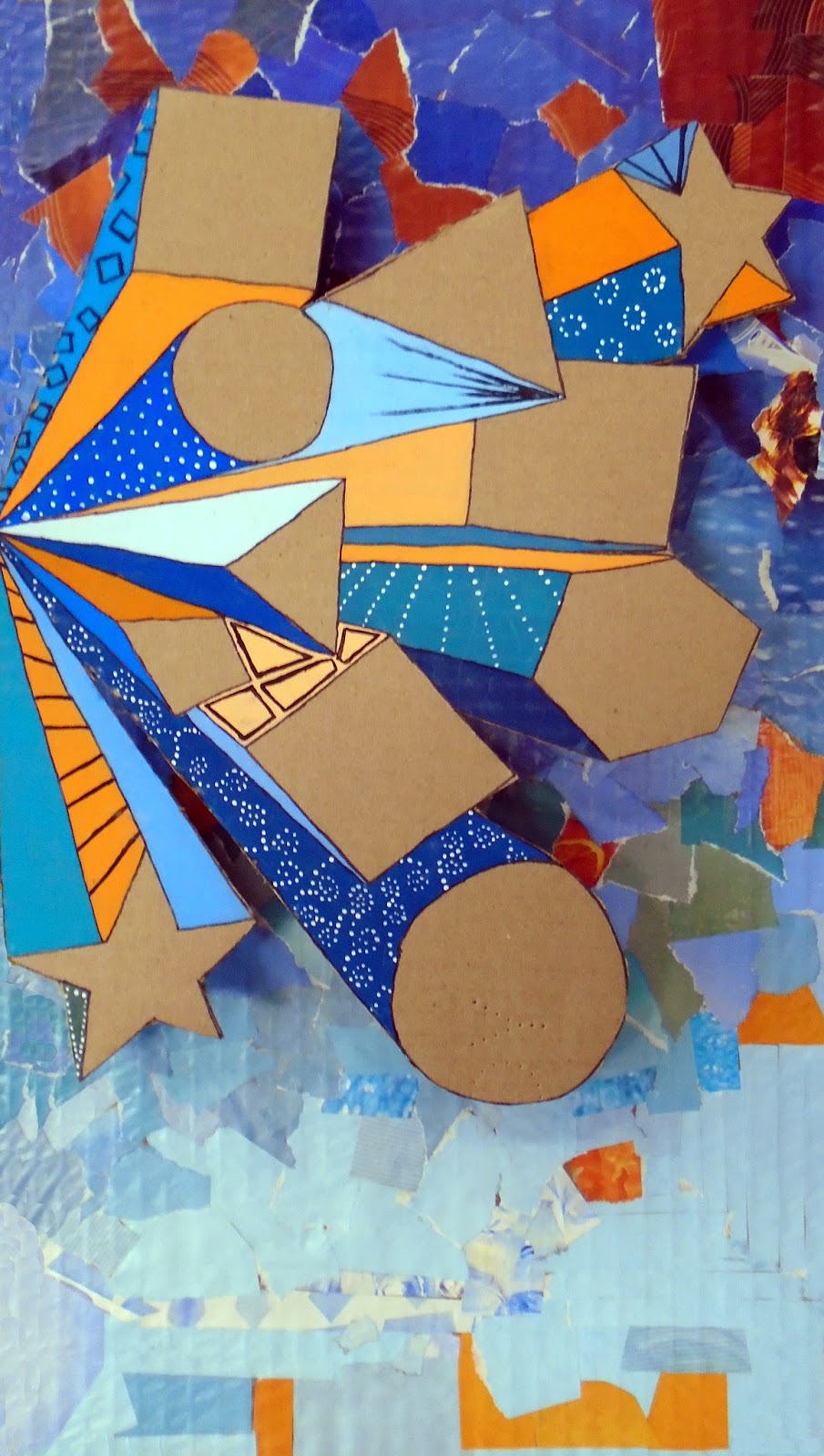
Artists will create a mixed media collage that contains forms in one point perspective.
Students may use cardboard, paint, newspaper, construction paper, etc. for their artworks.


 1. Create one point drawing using Geometric shapes.
2. Cut out drawing and transfer to Cardboard box. Cut out the design to check for a balanced composition, then re-draw the 1pt drawing using the first technique
3. Discuss Color Schemes, Warm and Cool colors. Have students paint the "tails" of their drawings using a Color Scheme they have pre-developed.
4. Paint
5. Once the boxes are painted student may cut out perspective drawing and create cardboard squares to support the relief {see below} Cardboard squares are painted and the box is designed with magazine collage techniques.


5th-8th- A Very Special Pageant T-Shirt Contest

This annual pageant began in 2011 at Fountain Lake School in Hot Springs, Arkansas. It was started so that children with special needs could receive recognition and praise for their unique beauty, personalities and talents.  The pageant has grown in popularity. Contestants and escorts come from many counties around Hot Springs.  Any school-age boy or girl with special needs is welcome to participate in the pageant.  One of the highlights of the pageant is the talent showcase.  Contestants and escorts who choose to participate in the talent show have wooed the audience with singing, lip syncing, dancing, cheering, gymnastics and cheering.  All contestants receive a crown and sash, with one overall winner named in each division. All escorts receive a trophy. Talent participants are awarded a medal. If you have never attended A Very Special Pageant, you need to make plans to do so.  Many people have stated that it is one of their favorite events of the year.


This year's event is titled "Over the Rainbow" and has a Wizard of Oz theme. Using the t shirt template provided, design your shirt with this theme in mind. If your shirt wins it will be the shirt used for the pageant this year and will be worn by many people around Garland County! 


AR Standards 5th: CR1.5.2 P5.5.1 P6.5.1 R7.5.1 R9.5.1
AR Standards 6th: CR 1.6.2 CR1.6.3 R8.6.1 R9.6.1 
AR Standards 7th: CR3.7.1 R8.7.1 

7th- Art and Nature/Unit 5

This unit features ways that artists help communities connect to nature and to appreciate its beauty throught their scientific and expressionistic investigations. Students will examine some crafting traditions and create an expressive nature scene from a macro perspective. They will also learn how the Tiffany studio pioneered the Art Nouveau movement.


DAY 1

1. Read Unit 5 Intro and Section 5.1 (p. 122-127)
2. Complete Check Your Understanding Worksheet
3. Define vocabulary words on back of worksheet.


DAY 2


1. Complete the What You Like worksheet and the Stylized Animals worksheet.


DAY 3

1. Read Section 5.2 (p. 128-131)
2. Complete the Check Your Understanding worksheet
3. Complete Practice: Creating Patterns (p. 129)


DAY 4


1. Look at Studio Time: An Expressive Scene
2. Choose a macro-photograph from nature that you would like to draw.
3.  Use color in an unexpected way to help express an idea or emotion.


AR Standards: CR2.7.1 P4.7.1 R8.7.1 

5-8/ Have a HeArt for Art

Students throughout the Fountain Lake School District will be participating in the annual
Have a HeArt for Art Competition.
You may create any heart related artwork that you would like for this contest.